Competition
The Horseball Championship Calendar: European, World and Club Titles
Five competitions carry the sport internationally. This is what the horseball championship calendar consists of, how often each title is contested, and the full record of who has won it.
Horseball does not run a season in the way club football does. The horseball championship calendar is a set of title events, each held every year or two, usually attached to a major horse show that already has an audience. There is a World Cup, three European championships: Senior, Lady and Under-16 pony, and a Champions League for clubs, plus regional international competitions around the edges.
The gaps matter as much as the dates. A European Championship that skips 1997, 2004 and 2008 is a competition being fitted around host availability rather than run to a fixed cycle, and the years it skipped are mostly years when something else, a first Junior European Cup, a first World Cup, took the slot.
Latest holders across the calendar
| Competition | Latest champion | Edition | Level |
|---|---|---|---|
| CompetitionMixte World Cup | Latest championFrance | EditionI · 2008 · Ponte de Lima | Level |
| CompetitionEuropean Senior Championship | Latest championFrance | EditionXVI · 2011 · Montpellier – EquiSud | Level |
| CompetitionEuropean Lady Championship | Latest championFrance | EditionVI · 2010 · Saint-Lô | Level |
| CompetitionEuropean Pony Under-16 Championship | Latest championSpain | EditionVIII · 2011 · Jaszkowo | Level |
| CompetitionEuropean Mixte Champions League | Latest championCardedeu (Spain) | EditionV · 2011 · Ponte de Lima | Level |
Every edition of every competition
The European championship cycle
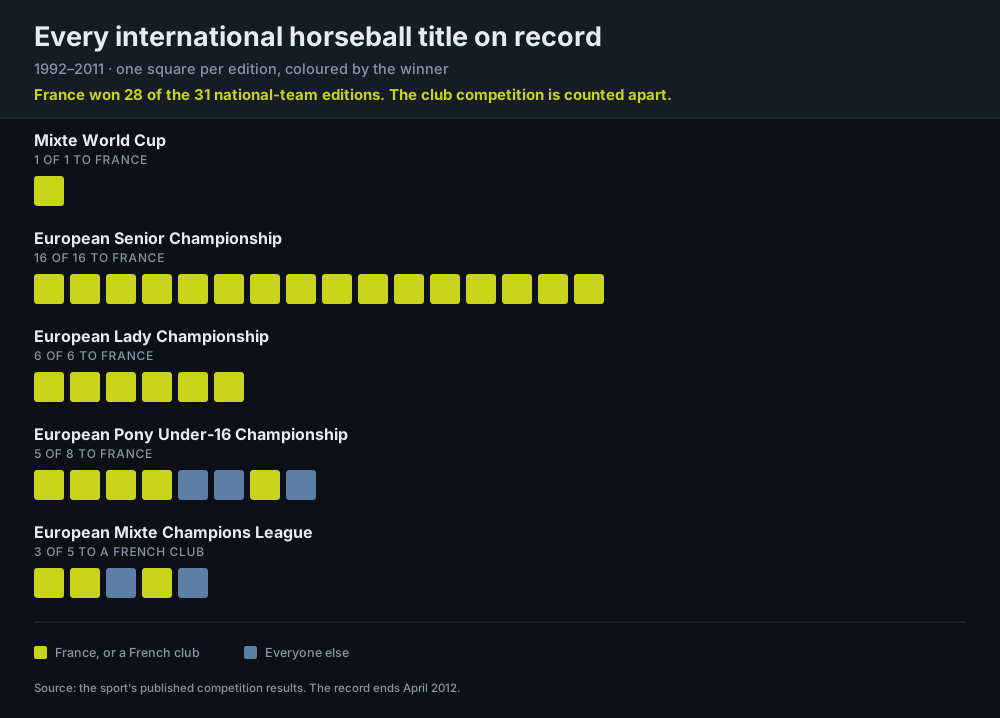
The senior title is the oldest and the most revealing. Sixteen editions between 1992 and 2011, and France won every one of them. Spain, Portugal and Belgium rotate through the other two podium places; Italy and Austria appear occasionally. A European championship in this sport has, for its whole recorded history, been a contest for silver.
The first edition was played at the Salon du Cheval in Paris in 1992. The second was at Wembley, inside the Horse of the Year Show, an early sign that the sport's growth strategy was to appear where equestrian crowds already were. Almost every horseball championship in this record was staged inside somebody else's event.
- 2011
XVI · France, Montpellier – EquiSud. France beat Spain, with Belgium third.
- 2009
XV · Spain, Oviedo. France beat Spain, with Belgium third.
- 2007
XIV · France, Saint-Lô. France beat Spain, with Portugal third.
- 2006
XIII · Belgium, Neeroeteren. France beat Italy, with Belgium third.
- 2005
XII · Italy, Milan. France beat Belgium, with Spain third.
- 2003
XI · Portugal, Reguengos de Monsaraz. France beat Portugal, with Belgium third.
- 2002
X · Portugal, Beja. France beat Portugal, with Belgium third.
- 2001
IX · France, Paris – Salon du Cheval. France beat Belgium, with Italy third.
What the calendar leaves out
Three competitions sit in the structure with edition numbers and no results at all: a Champions League for under-16s, a European American Cup and an Asian Cup. Two of them carry numbered rows, which means somebody laid the table out expecting to fill it.
That is a different kind of information from a result. A calendar with an Asian Cup drawn up and never held tells you where the sport intended to go, and the distance between the intention and the record is the honest measure of how far it got. The same applies in reverse to the women's championship, whose seventh edition is known to have taken place in 2012 and whose podium is not in the record. One is a plan without an event; the other is an event without data, and a calendar that reports both is more useful than one that quietly drops the rows it cannot fill.
World and club titles
The world-level competition arrived late. A World Cardon Pato-Horse-Ball Championship was held in Buenos Aires in 2006 with ten nations entered, and the first Mixte World Cup followed at Ponte de Lima in 2008, France taking the title from Spain, with hosts Portugal third. That edition also brought Argentina, Brazil and Canada into the international field for the first time.
The Champions League is the club competition, and the interesting one. Chambly won the first two editions in Stockholm; after that Cardedeu of Spain took two titles, Blanzac of France one, and Caramel of Belgium reached the podium in three consecutive years. Whatever keeps France unbeaten at national level does not transfer to their clubs.
Sixteen from sixteen, and what the rest of the record looks like
Scroll the chart sideways to read the whole record
Questions about the horseball championship calendar
How is the horseball season structured?
The international calendar is built around a small number of title events rather than a league running all year. A European Senior Championship is the anchor; a Lady championship and an Under-16 pony championship run alongside it; a club Champions League sits separately; and a World Cup sits above all of them. Regional international competitions fill in around the titles.
How often is each championship held?
Not annually, and not on a fixed cycle. The European Senior Championship ran sixteen editions between 1992 and 2011: roughly every year or two, with gaps in 1997, 2004 and 2008. The Lady and Under-16 championships were newer and less regular. Only one World Cup edition appears in this record.
Which nations host?
France and Portugal most often, followed by Italy, Belgium, Spain, the United Kingdom, Germany, Austria, Sweden and Poland. Hosting is frequently attached to an existing horse show: the Salon du Cheval in Paris, Fiera Cavalli in Italy, the Horse of the Year Show at Wembley in 1993, which is how the sport reached large audiences early on.
Are club and national competitions separate?
Yes. National-team championships are contested between countries; the Champions League is contested between named clubs such as Chambly, Cardedeu, Caramel and Blanzac. The club competition is also the one where the French national dominance does not hold.