Polo
Persia, then India and Britain
The oldest and best-known of the mounted ball games, and the only one most people can name. Played over a very large grass field in timed chukkas, with ponies changed between them.
Comparison
Five sports, five different objects to throw or hit, one shared problem: doing it at a gallop. What separates the mounted ball games from each other.
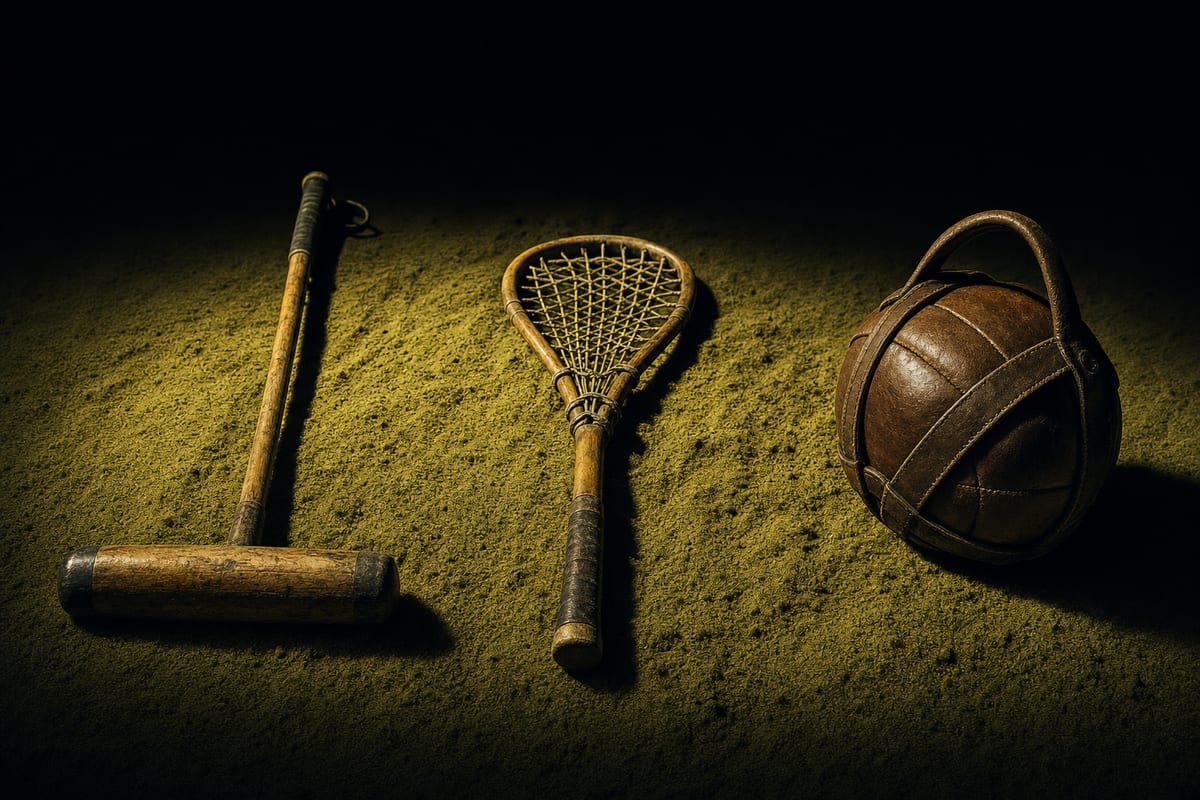
Ask what sport played on horseback involves a ball and most people will say polo, then stop. There are at least five, they are not variations on one another, and the differences are larger than the similarities, a polo mallet and a buzkashi carcass are not the same category of object.
Every sport played on horseback in this list solves the same problem in a different way, and the games played on horseback that survived are the ones whose solution was cheap. What the games played on horseback do share is a constraint. Every one of them is limited by what a rider can do one-handed while controlling half a tonne of animal at speed, and every rule that looks arbitrary usually turns out to be a solution to that. Horseball's three-pass requirement, polo's line-of-the-ball, polocrosse's one-horse rule: each exists because something about mounted play needed constraining.
| Sport | Riders | What is played with | How you score |
|---|---|---|---|
| SportPolo | Riders | What is played with | How you score |
| SportHorseball | Riders | What is played with | How you score |
| SportPolocrosse | Riders | What is played with | How you score |
| SportPato | Riders | What is played with | How you score |
| SportBuzkashi | Riders | What is played with | How you score |
Persia, then India and Britain
The oldest and best-known of the mounted ball games, and the only one most people can name. Played over a very large grass field in timed chukkas, with ponies changed between them.
France, from Argentine pato
The only one of these games played in a standard riding arena, and the only one that requires three passes between three players before a goal counts. No stick, the ball is carried, passed and thrown by hand.
Australia, 1930s
Sometimes described as lacrosse on horseback. One horse per player for the whole match, which makes it far cheaper to play than polo and is much of the reason it spread.
Argentina: the national sport
Horseball’s direct ancestor. Historically played over enormous distances, pitches ran to around 300 metres, which is exactly what had to change before the game could work indoors in Europe.
Central Asia
The most physically brutal of the mounted games and the least standardised, with rules varying widely by region. Its relationship to the others is thematic rather than genealogical.
Only one line of descent here is documented rather than assumed. Horseball comes directly from pato: the first trials used a pato ball, pato goals, pato priority rules and the pato pick-up. A French cavalry officer adapted it in 1936 and French instructors rebuilt it in the 1970s, shrinking a 300-metre Argentine field down to a 65-metre riding arena.
Polo's relationship to the rest is parallel, not parental, it reached Europe from India in the nineteenth century and influenced the others as a template for what a mounted team sport could look like. Paddock polo, a smaller variant, was on the same 1979 French programme as the first horseball matches. Polocrosse was assembled in Australia in the 1930s from polo and lacrosse. Buzkashi is older than all of them and connected to none.
One shared decision separates the accessible games from the expensive one. Polo rotates ponies between chukkas, so a competitive string is the dominant cost of entry. Horseball and polocrosse each run a whole match on one horse, and each fits a facility that already exists, an arena in one case and an ordinary field in the other. That is why a rider with a single horse can enter either of them and cannot realistically enter polo, and it has been true since polo reached Europe in the nineteenth century.
If you want the detail on the one game in this list with a fully recorded lineage, that is the history of horseball, and pato itself.
Several. Polo is the famous one, played with a mallet. Horseball is played with a handled ball thrown by hand through a raised ring. Polocrosse uses a netted racquet. Pato, horseball’s Argentine ancestor, uses a handled ball through a hoop. Buzkashi substitutes a carcass for a ball altogether.
Almost everything except the horse. Polo uses a mallet and a hard ball on a very large grass field, scoring between posts. Horseball is played by hand in a riding arena the size of a school menage, scoring through a ring three and a half metres up, and requires three passes between three team-mates before a goal counts. Polo rotates ponies between chukkas; horseball does not.
Polocrosse and horseball are both far more accessible than polo, for the same reason: one horse per rider and a much smaller playing area. Horseball in particular was designed in the 1970s to be playable in an ordinary riding school on ordinary school horses, that was the point of it.
None of them. Polo was on the Olympic programme five times up to 1936 and has not returned. Horseball was recognised by the FEI as an official equestrian discipline in 2004, which is a different thing from Olympic inclusion; the equestrian Olympic programme remains dressage, jumping and eventing.