History
Horseball History: the Origins in Pato and the French Codification
A cavalry officer, a war, and a federation that wanted riding lessons to be less miserable. The history of horseball is shorter and stranger than most equestrian sports.
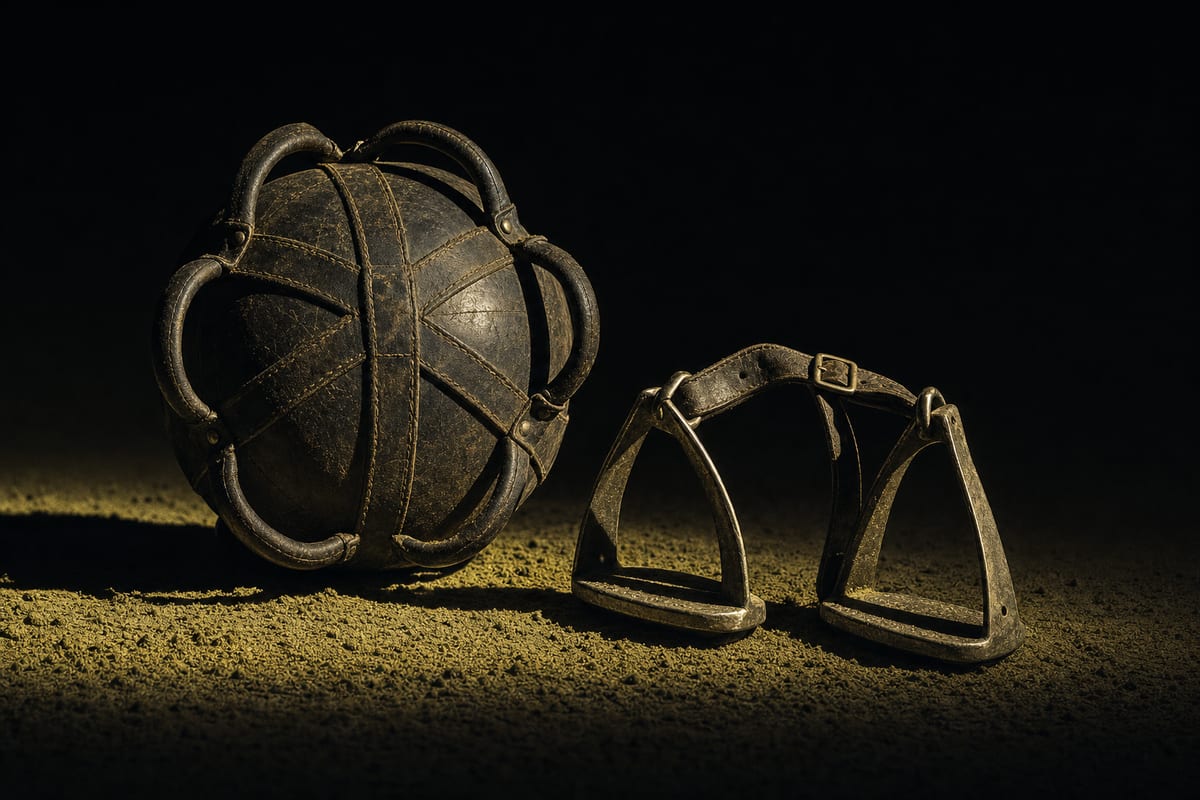
Every horseball history begins in the same place: Argentina, and a game called pato. Horseball is a direct heir to it. The earliest trials were played with a pato ball, through pato goals, under pato priority rules, using the pato technique for lifting the ball off the ground, in those years without even a strap joining the stirrups together, which tells you something about the riders.
What makes the origins of horseball unusual is that the sport was not invented so much as shrunk. Argentine pato was played over roughly 300 metres. Nothing about that fits inside a covered European riding school, and the entire early history of horseball is the record of people cutting the game down until it did.
The origins: pato, and a cavalry officer in 1936
Pato reached France through Captain Clave, a champion show-jumper of the 1930s. In 1936 he changed several of its rules, the size of the ball among them, and considered the result different enough to deserve a new name: horse-ball. It drew real interest. Matches were played at horse shows between cavalry regiments.
Then the war came and the game effectively died. For years it survived only inside a few riding clubs, kept alive not as a sport but as a drill: an exercise for deepening a rider's seat. Pato itself returned to public view afterwards in its Argentine form, presented regularly by the stuntman Mario Lurashi. This is why the horseball history told by the sport's own documents starts in 1936 and then jumps three decades.
The French revival: two instructors and a bureaucratic decision
In 1970 the French equestrian federation decided to develop equestrian games, with an aim that had nothing to do with competition: riding instruction was overwhelmingly delivered by ex-military staff and left little room for enjoyment. Period cartoons of the instructor bellowing across the school were not much of an exaggeration.
Two men in two regions moved first, Pascal Marry in Provence and Jean-Claude Gast in Centre-Val-de-Loire, both working riding instructors who later became regional technical advisers. Gast, drawing on the pato played in Lorraine, adapted a German pato ruleset that allowed a cross to be used for the pick-up. Both men went a long way afterwards: Gast to National Technical Director of the French federation, Marry to technical adviser at the ministry for Youth and Sports. It is a fair measure of how seriously the project was backed.
The first indoor pato match was played at the 1977 Salon du Cheval, Centre-Val-de-Loire against Provence, under a Commission for Youth and Games chaired by Philippe Lefebvre-Pontalis and later by M. Gaboriau. In November 1978 a seminar for regional technical advisers at the National Equestrian School in Saumur brought in two more people who mattered: Jean-Paul Depons, who went on to establish the base of the sport with the federation, and Philippe Thiebaut.
1979: the first championship, and the rules break from pato
In February 1979 the first French Championship of Equestrian Games was held at Poitiers. The programme was a mixed bag: two skill games, two relays, and two team games: paddock-polo and the sport then still called indoor pato. Its first rules were a compromise between pato (a handled ball, goals 2.70 m up) and Clave's horse-ball, which had allowed players to dismount to collect the ball. There was no pick-up strap yet, and only the Provence and Aquitaine teams could lift the ball while still mounted.
The first final deserves recording: Aquitaine, a side made largely of former rugby players, against a Northern team of four women. Aquitaine won, and then handed their opponents flowers at the prize-giving. Philippe Thiebaut and Jean-Paul Depons refereed, under Paul Lanchais, then National Technical Assistant Director.
By the second championship that October the lesson had landed. The rules needed to move further from pato, to suit small arenas and ordinary riding-school horses, and to look like a team sport rather than a display. Horseball was codified and its first rulebook published the same year. Thiebaut went off to found teams in Avignon and Salon-de-Provence; Depons put his time into coaching.
From French sport to recognised discipline
Here the horseball history stops being French and starts being international. From 1988 France began demonstrating the game abroad and other countries started building teams. The first European Cup followed in 1992, with England, Belgium, Germany, France, Italy and Portugal. An international federation was established in 1999 to run development, and the expansion after that is quick to list: demonstration matches at the 2002 World Equestrian Games in Jerez, a first women's European Cup in 2003, a first junior European Cup and FEI recognition as an official equestrian discipline in 2004.
The sport then went beyond Europe. A World Cardon Pato-Horse-Ball Championship in Buenos Aires in 2006 drew ten nations. A club Champions League started in Stockholm in 2007. The first World Cup was played at Ponte de Lima in 2008, and Argentina, Brazil and Canada entered the international field, the origins of horseball closing a loop back to the country that supplied the original game.
Horseball history in dates
76 years 15 entries 4 gaps of more than 5 years
- Origins A cavalry officer borrows a game from Argentina, and the war ends it.
-
1930s Equestrian games spread in France
Polo, paddock polo and pato de picadero spread through French riding circles.
-
1936 Captain Clave names it horse-ball
Captain Clave, a cavalry show-jumping champion, adapts pato, changing the ball among other rules, and calls the result horse-ball. The Second World War ends its first run.
- 34 years
- The revival A federation decides riding lessons should be enjoyable.
-
1970 The federation takes up equestrian games
The French federation sets out to build equestrian games into riding-school teaching.
- 7 years
-
1977 First indoor pato match
The first indoor pato match at the Salon du Cheval: Centre-Val-de-Loire against Provence.
-
1978 The Saumur seminar
A seminar at the National Equestrian School in Saumur brings in Jean-Paul Depons and Philippe Thiebaut. Depons lays the base of the sport with the federation.
- Codification Two championships in one year settle what the sport is.
-
1979 First championship, and the rules break from pato
The first French Championship of Equestrian Games at Poitiers includes horse-ball, then still called indoor pato. By the October championship the rules break decisively from pato and the sport is codified.
- 9 years
-
1988 The game is demonstrated abroad
France demonstrates the game abroad and other countries begin forming teams.
-
1992 First European Cup
The first European Cup: England, Belgium, Germany, France, Italy and Portugal.
- 7 years
- Going international From one country to a recognised discipline in sixteen years.
-
1999 An international federation
An international federation is established to run the sport worldwide.
-
2002 Demonstration at the World Equestrian Games
Demonstration matches at the FEI World Equestrian Games in Jerez.
-
2003 First women's European Cup
The first Women’s European Cup, at Abano in Italy.
-
2004 The FEI recognises the discipline
The FEI recognises horseball as an official equestrian discipline. The first Junior European Cup is held at Lamotte-Beuvron.
-
2006 Ten nations in Buenos Aires
The first World Cardon Pato-Horse-Ball Championship in Buenos Aires draws ten nations.
-
2007 First Champions League
The first Champions League, in Stockholm, won by Chambly.
-
2008 First World Cup
The first World Cup, at Ponte de Lima: France take the title, and Argentina, Brazil and Canada enter the international field.
Questions about the history of horseball
Who invented horseball?
No single person did, but 1936 is the year the name appears. Captain Clave, a show-jumping champion in the French cavalry, modified pato, including the size of the ball, and judged the changes significant enough to call the result horse-ball. The modern sport, though, was built in the 1970s by Pascal Marry and Jean-Claude Gast.
What is pato and how is it related?
Pato is Argentina’s national mounted sport and horseball’s direct ancestor. The earliest horseball trials used a pato ball, pato goals, pato priority rules and the pato pick-up technique. Argentine pato pitches ran to around 300 metres, which is precisely why the game had to change before it could work in a European riding arena.
When did horseball become an official discipline?
The FEI recognised it in 2004, in groups I and II. That followed demonstration matches at the 2002 World Equestrian Games in Jerez. The international federation itself had been established in 1999, seven years after the first European Cup.
Why did the sport start in France rather than Argentina?
Because the problem it solved was French. In 1970 the French federation wanted equestrian games to make riding-school teaching less military, instruction at the time was largely delivered by ex-military staff. Pato adapted to a small indoor arena answered that need; in Argentina there was no reason to shrink the game.