General Rules
The competition framework: which events count as international, who may enter them, and how disputes are settled.
Version 1.0, what it covers →Sport Rules, version 4.1
Twenty-seven numbered rules over 31 pages govern how the game is played. This page sets out what the horseball sport rules actually specify, and where the current official text lives.
Of the three documents that govern the sport, this is the one about the game itself. The other two deal with which competitions count and what a host venue must provide. The rules of horseball proper, covering pitch, goals, ball, teams, passing, pick-up, tackling and penalties, are all here. The document opens by stating the two things it cares about most: that the game is fast and physical enough to require players to know the rules exactly, and that the safety of horses and riders comes first.
Anyone hunting for the horseball rules in a single place usually means this document. It is worth knowing that the horseball rules are split across three of them, because roughly a third of the questions people ask about the rules of horseball are answered in the General Rules instead, and a further slice in the Organisation Rules.
One clause in the foreword is worth reading carefully, because it is the source of a common confusion. It describes the game as played between two teams of six riders. Rule 4 then says a team is six horses and six riders but only four may be on the pitch at any one time. Both are correct: six is the squad, four is the side. A team may carry on with three players, and no fewer.
Rule 1 sets the pitch between 60 and 75 metres long and 20 to 30 wide, ideally 65 × 25, excluding the security zone that runs down each side. The surface has to be level, soft, even and non-slip. This is an arena floor, not a field, and it may be indoors or out.
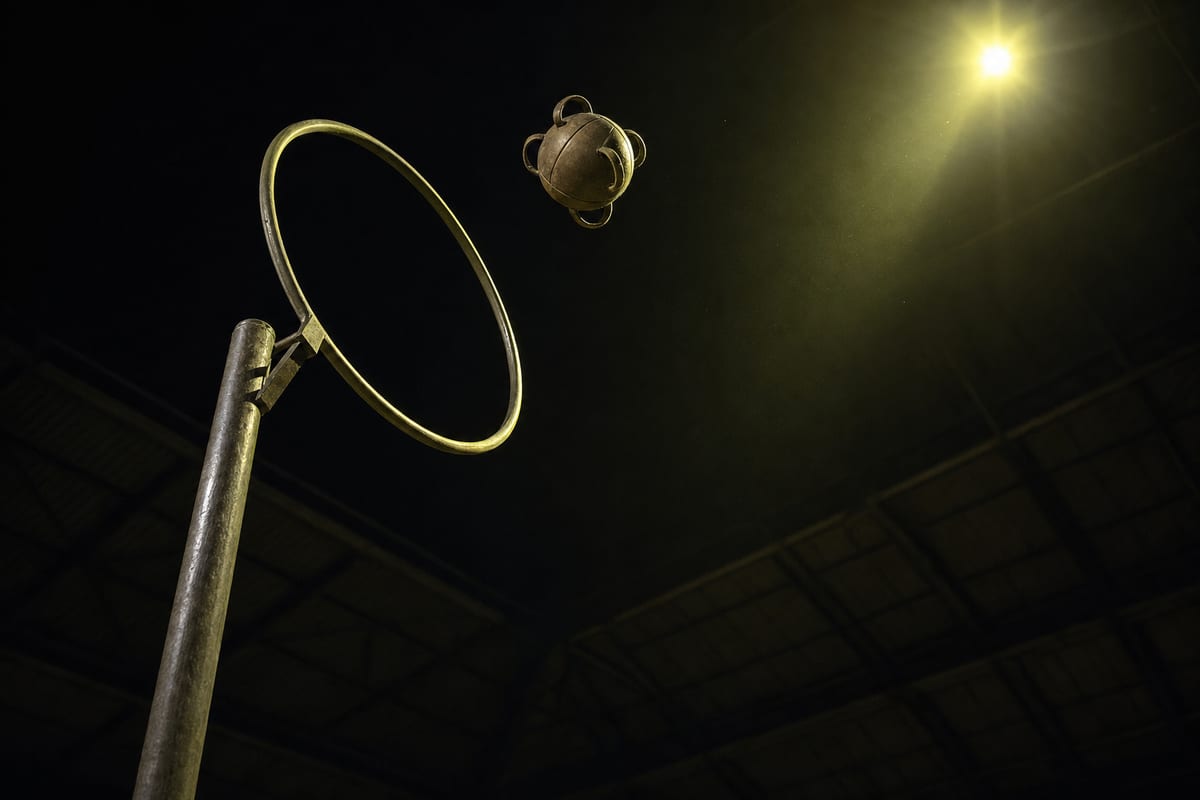
Rule 2 is the one that makes the sport look unlike anything else. The goal is not a mouth but a ring: one metre across, its frame 6 cm thick, hung vertically 2.50 m in from the end line with the base of the ring 3.50 m off the ground. To score you throw a ball through a hoop well above your own head, from a moving horse, having already passed it twice.
Rule 11 defines a pass as the interval between the ball leaving one player's hands and being touched by a second player on the same team. Handing it over does not count. Three passes between three different players are required before a goal can be allowed; a drop or an interception resets the count, while an opponent merely touching or deflecting the ball does not. No player may hold the ball longer than ten seconds.
Rule 15 governs the pick-up, and it is stricter than it looks. The ball must be collected without dismounting, at any gait, but never with the horse standing still. A player who fails to pick it up must not slow down, they have to clear at least five metres. Anyone else inside that five-metre zone must keep a straight line away from the ball without slowing. Changing direction or hesitating there is penalised, because that is where collisions happen.
Two referees run the match, one mounted and travelling with play, one seated with a view of the whole arena: with a radio link between them, alongside a supervisor, a ground jury and a veterinary surgeon. Three graded penalties and a technical foul cover the offences, with separate rules for dangerous or unsporting conduct, un-horsed players, broken tack, warnings, a disciplinary committee, doping and veterinary inspection.
Annex A adapts the whole ruleset for young and pony categories: smaller pitch, lower goals, a different ball, restrictions on tackling and its own refereeing and pick-up provisions. It is the part of the horseball sport rules that made the game teachable to children, and the only place in the horseball rules where a parameter as basic as goal height becomes negotiable.
The competition framework: which events count as international, who may enter them, and how disputes are settled.
Version 1.0, what it covers →The specification a host venue must meet: closer to a facilities checklist than a rulebook.
Version 5.0, what it covers →Between 60 and 75 metres long and 20 to 30 wide, excluding security zones, with 65 × 25 m treated as ideal. The surface must be level, soft, even and non-slip; indoor or outdoor, and an outdoor pitch has to drain well enough to stay playable in the wet. A security zone runs along each long side.
Two goals, one centred at each end. Each is a circle of one metre internal diameter made from material 6 cm thick, mounted vertically 2.50 m in from the end line with its base 3.50 m above the ground, so the top of the ring is around 4.50 m up. Rings are painted white and hung with a white net of 4 cm mesh.
A light-coloured size-4 junior football, 65 cm in circumference, inside a harness carrying six leather handles roughly 31 cm long. The handles are what make a mounted pick-up possible at all.
Two halves of ten minutes with a three-minute interval, controlled by an official timekeeper. Competition rules may shorten the halves, and where a team plays twice in a day the organisers may reduce them, a decision for the ground jury, which can take veterinary advice.
A player may bring their horse into contact with the ball carrier’s horse to slow it or push it off line, using body weight and the horse’s speed with the shoulder, arm held against the body. It is forbidden above 45 degrees to the carrier’s line of travel, forbidden to push the rider anywhere, and forbidden to use the horse to strike them. Depending on severity that is a Penalty 1 or a Penalty 2.
With the sport’s international governing federation, at fihb.net. The version described on this page is 4.1; the rules have been revised since, and anyone refereeing or competing should work from the federation’s current edition rather than a summary.